
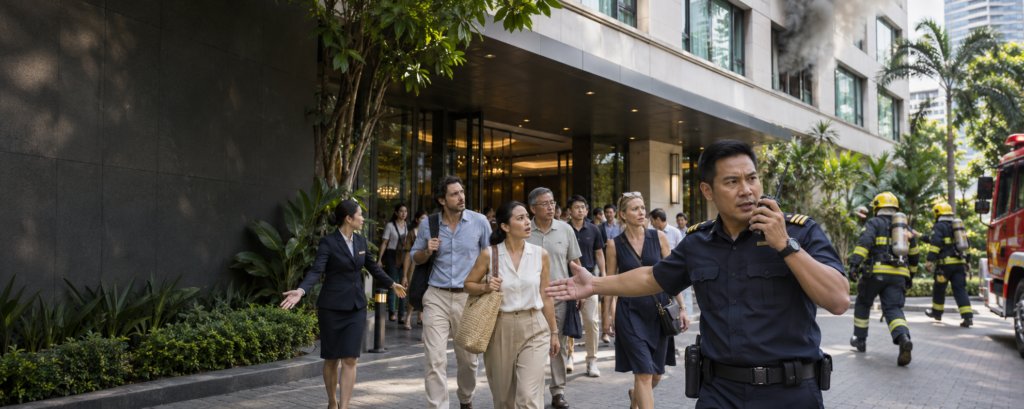
THE SHOCK
Anticipating the Event, Preparing the Response
1. Shock: A Disruption to Normal Operations
In the field of security, a shock can be defined as the occurrence of a sudden event that significantly disrupts the normal functioning of an organisation, establishment or activity.
Whether it involves a fire, an accident, an intrusion, an assault or a major technical failure, a shock marks the transition from a situation considered to be under control to one requiring an immediate response.
Its severity can vary considerably. Some incidents will be brought under control quickly, while others may cause significant harm to people or property. Such situations require immediate, coordinated and carefully managed interventions, particularly to prevent secondary incidents and ensure a calm, professional response.
Although the precise moment at which an event will occur is generally unknown, the nature of many events capable of causing a shock can nevertheless be identified in advance.
2. Is a Shock Truly Unpredictable?
Although the suddenness of a shock may initially cause surprise and disbelief, its potential consequences can often be anticipated through an understanding of the risks involved.
A fire in a hotel, an intrusion into an embassy, an accident in a business or an assault at an international school are all examples of events whose exact timing and circumstances are virtually impossible to predict. Nevertheless, the very fact that we can identify and describe them demonstrates that we are already aware of their possibility.
Should we, then, really describe them as unpredictable?
The answer requires some nuance. Although uncertainty remains as to whether and when such events will occur, their nature and some of their consequences are often known. They are not necessarily unforeseen situations: they belong to a range of risks to which an organisation may reasonably be exposed, which it should seek to identify as comprehensively as possible and prepare to address.
It is therefore essential to distinguish between the unpredictability of an event’s occurrence and an organisation’s ability to respond to it.
This distinction is fundamental. No organisation can claim to prevent every incident, accident or malicious act. It can, however, identify situations that may give rise to such events, assess its vulnerabilities and prepare appropriate responses.
Consider the example of a hotel fire. No one can predict that a fire will break out on a Tuesday at 2 p.m. in a room on the fourth floor. Yet the risk of fire is well understood. This is precisely why fire detection systems, firefighting equipment, evacuation procedures and staff training are put in place to limit its consequences.
The same applies to an intrusion, an assault or a major technical failure. An event may come as a surprise because of its timing or origin, but its nature should not necessarily be unexpected.
Nevertheless, some events fall outside previously identified scenarios. Emerging threats, changing behaviours or combinations of failures can challenge even the best-prepared organisations.
In such circumstances, it is also necessary to question whether our understanding of the operating environment remains accurate, how that environment is evolving and how the associated risks are changing. An event that was not anticipated does not necessarily indicate a failure in the initial assessment, but it should prompt a review of its underlying assumptions.
Preparation must therefore go beyond a fixed list of known situations. It must also develop teams’ ability to observe, analyse and adapt when confronted with the unexpected.
Anticipating a shock does not mean predicting the event. It means equipping ourselves to respond to it.
This approach rests on a fundamental process, too often regarded as a mere administrative formality: risk assessment.
Risk assessment is one of the essential foundations of any security policy. Far more than an inventory of potential hazards, it is a structured process designed to understand an organisation and its environment, assess its exposure to risks and guide the decisions necessary for its protection.
3. Preparing for Shock: From Risk Assessment to Response Capability
Understanding risks is only the first step. That knowledge must then be translated into practical measures capable of preventing certain events, limiting their consequences and enabling a rapid, appropriate and controlled response when a shock occurs.
This preparation can be organised around three complementary components: Structure, Equipment and Human, brought together under the acronym SEH.
Rather than simply classifying protective measures, this approach provides a logical framework for design, investment and operational preparedness.
Structure: Providing Protection Before Intervention Is Required
Structure is the first consideration. It encompasses the building’s design, internal layout, access points, circulation routes and permanent features intended to protect people and property.
Depending on the risks identified, structural arrangements may allow areas to be compartmentalised, refuge or shelter-in-place areas to be created, protected rooms to be established, emergency supplies to be stored and suitable evacuation routes to be incorporated.
The management of movement and circulation is particularly important. The positioning of corridors, staircases, doors and other openings can either facilitate or obstruct movement. Depending on the nature of an event, it may be necessary to evacuate a building quickly or, conversely, direct its occupants towards a protected area.
The structure must therefore be considered in relation to the risks facing the establishment, rather than solely in terms of architectural constraints or everyday operational requirements.
There is also an economic reason for addressing structure first: structural modifications are generally expensive, time-consuming and difficult to reverse. A wall that has been built, a staircase that has been installed or a circulation route that has been altered cannot simply be moved whenever requirements change.
It is therefore important to make the best possible use of structural opportunities before turning to other protective measures.
However, the design of any establishment must first serve its purpose: accommodating guests, producing goods, providing education or delivering services. Economic viability and day-to-day operations are therefore essential considerations.
Security cannot be considered independently of these objectives. A completely sealed establishment, where no one could enter or leave, might be protected against certain external threats, but it would also be unable to carry out its activities.
This is where collaboration between architects and security auditors becomes particularly valuable. From the earliest design stages, an auditor can identify potential vulnerabilities and recommend structural adjustments that improve protection without compromising the establishment’s ability to function.
Such collaboration is especially beneficial when it takes place before construction begins. In an existing establishment, the scope for structural modifications may be more limited and the associated costs significantly higher.
The objective is therefore not to pursue absolute security, but to incorporate structural protections compatible with the organisation’s activities and then complement them with appropriate equipment and human resources.
Equipment: Detecting, Informing and Complementing Passive Protection
Once structural possibilities have been considered, equipment provides the next layer of protection.
Its selection should begin with one fundamental question: what information do we need to identify a potential danger and prepare an appropriate response?
Depending on the risks involved, this may mean detecting an intrusion, unusual movement, the presence of a dangerous object, abnormal vibrations, the outbreak of a fire or a concerning change in the surrounding environment.
Cameras, sensors, scanners, alarm systems and access-control devices are all technical resources whose functions should be determined by the establishment’s actual needs.
A camera, for example, is not merely a recording device. Depending on its features and configuration, it can also serve as a detection and alert system. Some equipment can contribute directly to protection by controlling access, delaying an intrusion or automatically triggering a predefined action.
Another advantage is its relative adaptability. Unlike structural modifications, many types of equipment can be added, relocated, replaced or reconfigured as risks evolve.
Although such systems require an initial investment and ongoing maintenance and eventual replacement, they can often expand an organisation’s protection and monitoring capabilities without a proportional increase in staffing levels.
However, a security auditor’s expertise is not limited to knowing which products are available. It also lies in the ability to recognise and exploit their capabilities, sometimes beyond their original intended use, to develop relevant, effective and economically reasonable responses to identified risks.
The aim is not necessarily to install additional devices, but to determine the most effective way of obtaining the required information, including by making better use of existing resources.
Nevertheless, detecting a signal does not necessarily mean identifying the precise threat or knowing how to respond.
This is where the third component becomes essential.
Human: Understanding, Deciding and Acting
The human element is decisive in delivering an operational response — what we refer to here as active security.
To act effectively, personnel must first understand their environment. Knowing where a staircase or emergency exit is located is not enough. They must also understand why particular areas have been designed as they are, what protection they provide and under which circumstances they should be used.
This knowledge includes refuge areas, shelter-in-place locations, evacuation routes and the resources available to deal with exceptional situations.
Personnel must also understand the security equipment in place: where it is located, what it is designed to do, what information it provides and what different alerts mean.
The objective is to enable individuals to identify the likely nature of an event quickly and initiate the appropriate first measures.
This is precisely the purpose of emergency response action cards.
Developed from the scenarios identified during the risk assessment, these cards set out the actions to be taken in response to situations such as an intrusion, an assault, a fire, a serious accident or any other threat relevant to the establishment.
Each identified risk or threat requiring an operational response should therefore be addressed by an appropriate action card, specifying the initial measures to be taken when the event occurs.
These cards must be clear, readily accessible and tailored to individual responsibilities. A security officer, receptionist, technical manager and general manager will not necessarily have the same actions to perform.
However, knowing the procedures, while essential, is not enough.
A procedure that is understood is not necessarily a procedure that has been mastered.
Training: Reducing the Time Lost to Shock and Hesitation
Managing shock within an organisation is comparable to managing stress in an individual.
When confronted with a sudden threat, a person may experience a moment of freezing or psychological paralysis. Familiar reference points disappear, decision-making may be temporarily impaired and the ability to react may be delayed.
An organisation can experience a comparable phenomenon.
When a serious event occurs, normal activities are abruptly disrupted. Personnel hesitate, seek instructions, wait for decisions or struggle to understand what is happening. For a brief period, the establishment may appear almost immobilised.
Yet this period of hesitation can be critical.
Preparation must therefore aim to reduce the time between recognising a danger and initiating the first appropriate actions.
Theoretical training alone is insufficient. It must be supported by regular practical exercises that reflect real operational conditions as closely as possible.
Practising evacuations, establishing security perimeters, preserving evidence at an incident scene, managing gatherings or implementing shelter-in-place procedures helps personnel develop practical operational reference points.
Team exercises are particularly important. They help verify that everyone understands their responsibilities, that information flows correctly and that coordinated actions can begin without a succession of improvised instructions.
Training cannot eliminate every reaction of surprise or freezing. It can, however, help reduce their effects, develop appropriate automatic responses and preserve greater mental capacity to assess the particular circumstances of an event.
The objective is not to teach personnel to act blindly, but to enable them to carry out well-practised initial measures without hesitation, while retaining their capacity for sound judgement.
This distinction is fundamental.
An organisation may have a carefully designed building, advanced security equipment and meticulously written procedures. If its personnel do not know how to mobilise these resources when an event occurs, much of its preparedness remains theoretical.
An organisation’s true ability to withstand a shock is measured not merely by the resources at its disposal, but by its capacity to mobilise them together, effectively and without delay, when circumstances demand it.