
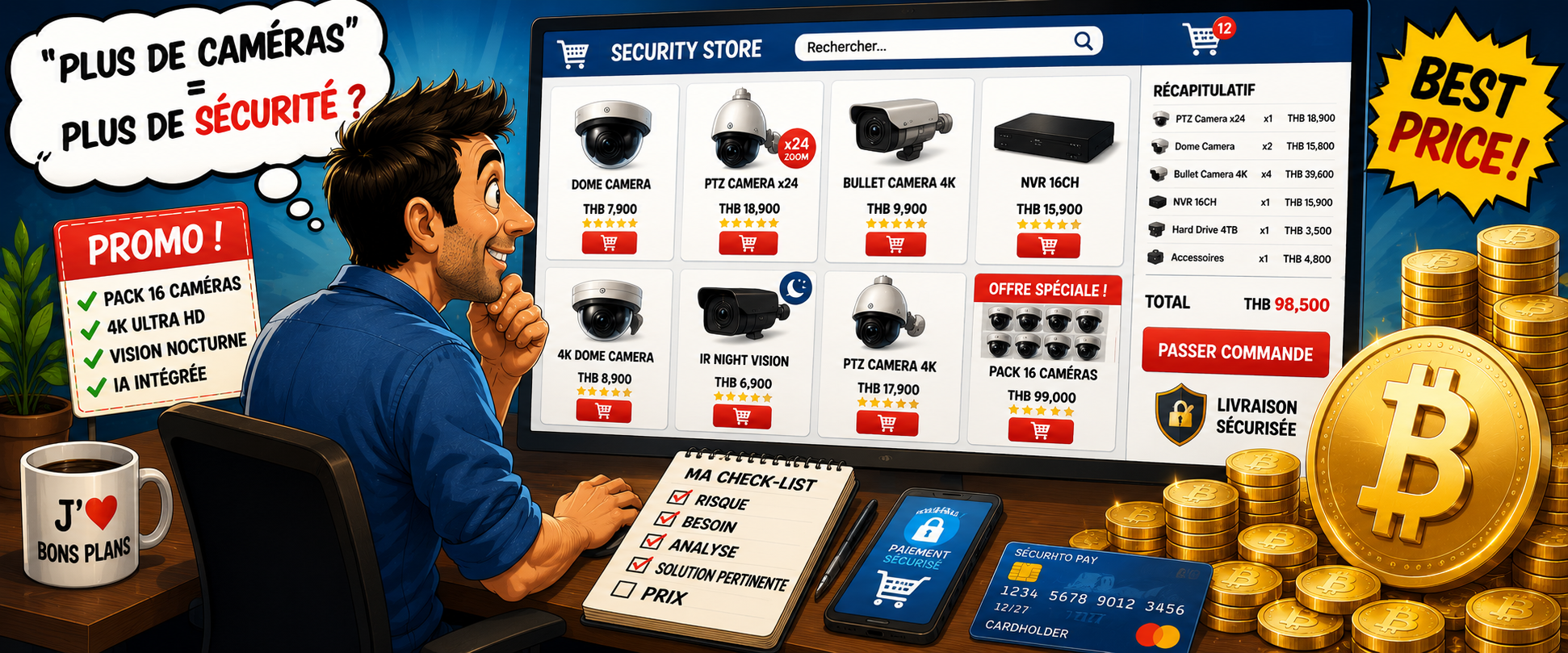
As on every morning, the security guard carries out his patrol. He notices signs suggesting that an attempted intrusion took place during the night and immediately informs the director. The director comes to inspect the scene and reaches what seems to him an obvious conclusion: they need cameras.
He might just as easily have considered raising the wall, assigning a second guard to night patrols, installing detectors, or even allowing a dog to roam freely with the appropriate warning signs. But no: his first instinct was the camera.
So he calls an installer. The installer visits the site, examines the areas to be covered and proposes a suitable CCTV system: several cameras, good resolution, night vision, a recorder, storage and, why not, a few intelligent analytics features. Perhaps even a PTZ camera with ×24 optical zoom — a magnificent camera.
The quotation is expensive, but it is approved. The system is installed. The images are excellent.
A few months later, another attempted intrusion occurs. This time, however, the owner has something he did not have before: a very good video. It shows that something happened, without having prevented anything from happening.
The system works; there is no question about that. The cameras perform their function perfectly. Yet security has not necessarily improved, because nobody had first established whether that function actually addressed the security requirement.
It would be easy to conclude that the installation was poor or that the supplier had advised the client badly. That would clearly be unfair.
The installer did his job. He was asked for cameras; he proposed cameras. The mistake occurred before he arrived.
When the attempted intrusion was discovered, the owner confused a fact with a requirement, and then the requirement with a solution. Somewhere between “someone tried to get in” and “we need cameras”, the entire security analysis disappeared. He never really established what he was trying to achieve; he simply selected the means that appeared to answer the problem.
A camera is a means. It can contribute to a security solution, sometimes in an essential way. But a camera, on its own, does not define the requirement.
The first question should have been different:
What are we actually trying to achieve?
Do we want to understand what happened? Identify someone after the event? Detect a presence before an intrusion? Deter? Raise an alarm? Delay progress? Trigger a response? Give particular protection to certain areas?
The answers to those questions may indeed lead to the installation of cameras. They may equally lead to improved lighting, changes to a perimeter fence, relocation of an access point, additional detection, an organised alert procedure, or a combination of several measures.
Technology Comes After the Reasoning
In security, the solution should be defined by the person who understands the risk before it is priced by the person who sells the means of addressing it.
This principle does not call suppliers’ competence into question. A good CCTV installer knows the equipment, its performance, its constraints and its limitations. An access-control specialist does the same within that field. So does an alarm-system provider.
But each naturally approaches the problem through their own profession, their own tools and their own catalogue.
The role of the security professional is different.
It begins with the facts. The threat, vulnerabilities, potential consequences and site constraints are analysed. The required security effect is then determined — and that is the real objective. Only at that point should the means be selected and competent suppliers consulted.
The logic should therefore be:
RISK → REQUIREMENT → REQUIRED EFFECT → SOLUTION → SUPPLIER → PRICE
Not:
PROBLEM → SUPPLIER → CATALOGUE → QUOTATION
Price Is Not a Measure of Security
This distinction has an important consequence for decision-makers: an expensive solution is not necessarily excessive, just as an inexpensive solution is not necessarily wise.
If the risk requires a substantial, complex and costly system, that expenditure may be entirely justified. Conversely, when the required effect can be achieved through a simple measure, adding technology or multiplying equipment does not necessarily make the site safer. On the contrary, unnecessary complexity can quickly create confusion of its own.
The real criterion is therefore not the amount invested. It is the alignment between the identified risk, the required effect and the resources committed.
In other words, security is not about buying more. It is about buying what is actually necessary — or, in some cases, simply organising properly what is already there.
A Real-World Example
Anonymised true account — Certain contextual details have been deliberately altered or omitted. The professional principle described remains faithful to the situation encountered.
During a security audit at a large hotel, a perfectly legitimate requirement had been identified: improving the ability of certain members of staff to raise a discreet alarm and strengthening detection in a sensitive area.
Technical solutions had been sought, and a project costing approximately THB 900,000 had been proposed.
The issue was not that the technology was poor. It could have worked perfectly well. The question was much simpler: was it necessary to achieve the required security effect?
By reconsidering the problem from the beginning — threat, requirement, intended effect, building constraints and organisation of the available means — a far simpler architecture could achieve the objective for approximately THB 25,000.
It would be tempting to present this as a saving of THB 875,000, but accountancy is not the point of this story.
Indeed, had THB 900,000 been necessary to achieve the required level of security, it would have been money well spent.
The difference lies elsewhere: the requirement had been defined before the solution was considered.
That said, numbers do matter. The THB 135,000 audit and the THB 25,000 of appropriate equipment brought the total cost to THB 160,000. The actual saving was therefore THB 740,000.
The price of a solution is negotiated with a supplier. Its relevance is determined before the supplier is consulted.