
What we now call CCTV is, at heart, simply the modern expression of a very old human ambition: to see what is happening where we are not. A camera secures nothing on its own. It captures, may record, and then transmits visual information from a point beyond our immediate field of vision.
Seeing What the Eye Cannot
When it watches a blind spot, a secondary entrance or a remote area, it simply extends our sight. When an operator in Bangkok observes a site in Istanbul in real time, the principle remains the same: to obtain, at a distance, either an overall view of the situation or precise information about a particular point.
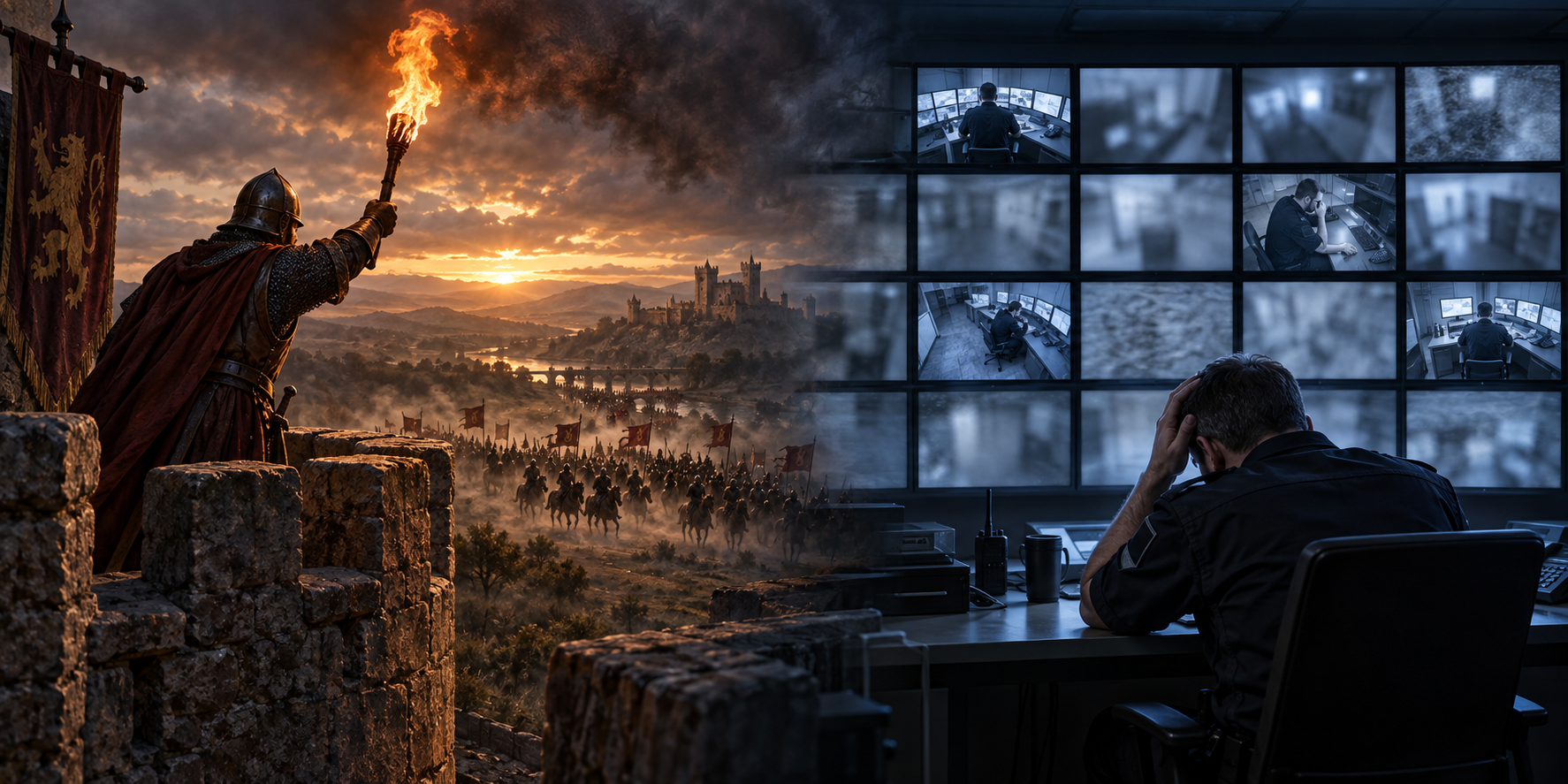
Long before cameras existed, this function was entrusted to a person. A watchman would be placed on high ground, on a tower or forward of a position. His role was to see farther than others and then send a signal when something occurred. The system contained no cable, server or screen—only a pair of eyes, a means of communication and someone expected to understand the message.
Ramparts, watchtowers and, later, carefully designed fortifications extended the same logic. Vauban’s works, for example, did more than place walls between a position and a threat: they also organised lines of sight, observation points and means of warning. Even then, the aim was not to see everything, but to see what mattered early enough.
Optical instruments then enabled the human eye to exceed its natural limits. The spyglass brought distant objects closer. The camera obscura projected an image; photography fixed it. Rapid sequences of images created the illusion of movement, electronics made it possible to transmit a video feed, and networks gradually freed observation from distance: the observer no longer had to be near what was being watched.
From the watchman to the connected camera, the fundamental principle has therefore changed very little: gather visual information at a distance and deliver it to the person who must interpret it and, if necessary, act. We have greatly improved the image’s range, accuracy, retention and transmission speed. We have not removed the need for judgement.
An image becomes security information only when it answers a question and forms part of a capacity to respond. This is precisely where the real subject begins: before choosing a camera, one must first know why.
When the Network Blinded the Watchmen
The arrival of IP technology in video surveillance represented a major advance. It made cameras easier to deploy, improved image quality, enabled remote viewing and allowed many devices to be integrated within a single architecture. The problem, therefore, is not IP. It is the confusion it has sometimes introduced into the allocation of responsibilities.
Once cameras were connected to a network, images were recorded on hard drives and access had to be managed, IT departments naturally became involved in CCTV projects. Their involvement was not only logical but essential: the network had to remain available, access had to be protected, equipment maintained and cyber intrusion prevented.
Another requirement was equally legitimate. The NVR, server and recordings contain sensitive data. They may preserve evidence of an intrusion, theft, assault or accident. Access must therefore be controlled, and the equipment protected against theft, damage, manipulation or deletion. On many sites, locating it in a secure technical room or server room is entirely appropriate.
Yet an intellectual slip occurred: because the technical core of the system had to be protected, the operational use of video surveillance was sometimes locked away with it. The monitors and viewing interfaces followed the recorders into the IT room, while the personnel expected to respond remained at their posts—with no access to the images.
We have thereby achieved a small historical feat: after centuries spent extending the watchmen’s sight, we installed hundreds of electronic eyes and then blinded them.
The system continues to record. After an incident, it can be used to find a sequence, understand what happened and, sometimes, provide evidence. That function is useful, but it comes too late to prevent the event or limit its consequences. A system designed solely to review the past is no longer truly a means of receiving operational information; it becomes primarily an investigative tool.
This does not, of course, mean taking the NVR out of its secure room and placing it on the desk of the nearest guard post. It means distinguishing two layers that should never have been confused: on one hand, a protected technical infrastructure, rigorously administered and maintained; on the other, controlled operational access enabling security personnel to view the relevant images, receive the necessary alerts and respond in accordance with established procedures.
IT must ensure the system’s operation, integrity and cybersecurity. Security must define what is to be observed, who may see it, under what circumstances and what action it should trigger. Neither profession replaces the other. When a project is carried out without that clear division of responsibilities, the installer often delivers exactly what was requested: a camera network that operates, records and plays back images. Technically, the contract has been fulfilled. Operationally, no one has necessarily checked whether the system genuinely enables anything to be protected.
The real question is therefore not merely where to place the NVR or who should hold the passwords. It is who needs to see what, why, and what should happen next. In other words, we must return to the “why” before rushing towards the “how”.
Installing Cameras Is Not Enough
The “how” does not begin with a brand, a model or a megapixel count. It begins with scenarios: what event are we trying to detect? Who must be informed? In what form? Within what timeframe? Above all, what action must that information trigger?
Depending on the equipment and video management software selected, an IP system can do far more than simply record. It may detect movement, monitor the crossing of a virtual line, report a presence within a defined area or distinguish between certain categories of object. An event may then trigger an alarm, start or enhance a recording, send an email or mobile notification and, through a suitable integration, forward the information to a messaging platform.
It can also change what the operator sees. A video wall displaying twenty or thirty cameras continuously does not ensure that the important event will be noticed. The system can, however, draw attention to the relevant camera, enlarge its image temporarily, display the appropriate view on a dedicated screen and then restore the interface to its normal state. Technology no longer asks the guard to look everywhere at once: it helps him look in the right place, at the right time.
Access rights can also be differentiated. An officer may be permitted to view certain cameras live without being able to access recordings, export footage or alter the configuration. Suitable systems can also apply privacy masks and, depending on the chosen architecture, reserve the temporary lifting of those masks for specified profiles or an escalation procedure, while preserving the necessary recordings.
Consider a particularly sensitive area, such as the private swimming pool of a diplomatic residence. The objective is plainly not to provide the guards with an endless serial about the ambassador’s private life. The normal view may be masked or restricted. A compatible analytical rule can, however, identify an abnormal situation—for example, prolonged immobility within a defined zone—and trigger an alert together with an authorised assistance procedure. Such a system must never be presented as certain drowning detection, nor replace human supervision or rescue arrangements. It simply illustrates that privacy and a capacity to respond can be reconciled, rather than sacrificing one entirely to the other.
This is where the real difference lies between selecting a function and designing a solution. A technical alert may not have been created for the precise scenario encountered on a particular site. A professional can, however, combine rules, assign an available event to an operational purpose or integrate several functions to produce the required behaviour. This is not about forcing the system beyond its limits; it is about understanding those limits, making intelligent use of the capabilities intended by the manufacturer and then testing the result under real operating conditions.
Yet this stage often disappears from the project. The installer has been asked to fit the cameras, connect them, verify that they transmit an image and ensure that recordings are available. Unless the contract also includes the design of security applications, it is not the installer’s responsibility to invent the client’s operational scenarios. When the installer leaves, the cameras may therefore work perfectly—which does not yet mean that the system fulfils its security mission.
That is why, when the client lacks this expertise internally, it is sensible to have the project designed by a security company in collaboration with a competent installer. The former translates risks and needs into scenarios, access rights, alarm rules and response procedures. The latter identifies the equipment capable of meeting those requirements, then supplies, installs, connects and maintains the technical architecture. Once the hardware is in place, the system must still be configured, tested and adjusted to the actual operating conditions.
At SDS, this continuity is provided in partnership with Nova Networks Solutions (NSS), our technical partner. SDS establishes the functional plan and defines the intended uses; NSS supplies, installs and connects the appropriate equipment; SDS then completes the operational settings, alarm integrations and adjustments required by the client.
This approach does not automatically produce a substantial increase in cost. Professional terms obtained from suppliers, together with the elimination of unnecessary or unsuitable equipment, can offset part of the design and configuration work. The comparison must nevertheless be made on a like-for-like basis: a quotation limited to installation and recording cannot fairly be compared with the cost of a system that has been configured, tested and integrated into the site’s procedures.
We have used CCTV as our thread because the camera is one of the most visible and widely understood pieces of security equipment, including among the general public. But the reasoning extends far beyond video surveillance. It applies to every form of security technology.
In access control, for example, choosing between a biometric fingerprint, a MIFARE card, a code or another means of identification is not a matter of novelty or personal preference. The choice depends on the required level of identification, the people concerned, traffic flows, the environment, continuity requirements, privacy considerations and the response expected when an anomaly occurs. The same is true of an alarm, intercom, sensor or any other device.
Every product has functions, possibilities and limitations. The same function can be configured, combined with others or used in different scenarios to produce very different results. The value of a security professional therefore lies not only in knowing the products, but also in being able to translate a need into an operational outcome, and then identify the functions and equipment capable of producing it.
Starting with a catalogue in the hope of finding a universal solution reverses the entire reasoning process. A product is purchased before it has been given a mission; only afterwards does someone decide where to put it and what it might be used for. No device can meet every need, because no two sites, risks or organisations are exactly alike. Regret may then set in: “I should have bought the blue one from the competitor; this one does not work.” It does work—just not for what you intended to do with it.
Technology must not dictate how security is organised. It should support human attention, judgement and action. The right system is therefore not the one with the greatest number of devices or functions. It is the one that delivers the precise answer to a clearly defined need, at the right time.
In security, we do not buy a tool first and then invent a mission for it. We define the mission, and only then do we choose the tool. You do not use a sledgehammer to crack a nut!