
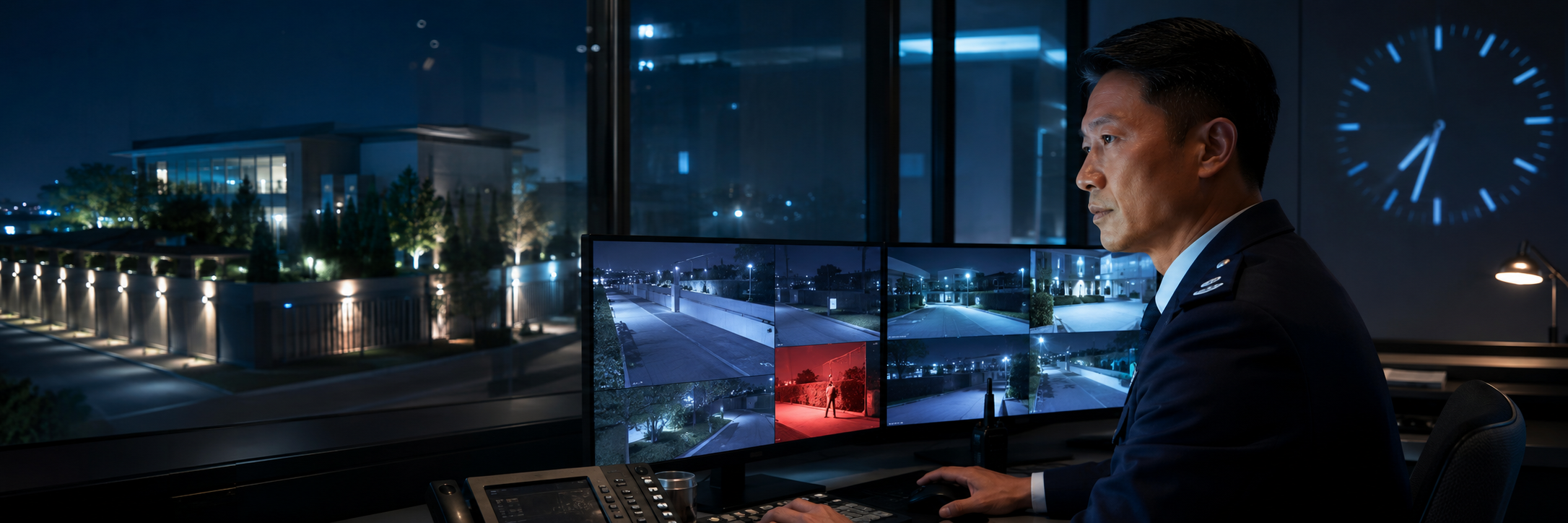
Protection is not about promising the impossible. It is about detecting threats early enough, delaying them effectively and enabling an appropriate response.
Absolute security does not exist.
A perimeter can be breached, a procedure circumvented, a camera disabled and a security officer caught off guard. No serious security professional would therefore claim that every intrusion, accident or malicious act can be made impossible. The objective is to reduce its likelihood, limit its consequences and, above all, remain one step ahead of the event.
In security, the decisive resource is not the number of guards, the quantity of cameras or even the size of the budget.
The first resource is time.
Detect Before Being Forced to React
A threat rarely materialises without warning signs.
An unusual presence around a site, abnormal behaviour, a door repeatedly left open, a procedure that has gradually become less rigorous or an out-of-service camera may all constitute valuable indicators. Individually, they may appear insignificant. Taken together, they may reveal a vulnerability or signal that a more serious event is developing.
The first function of a security system is therefore to detect these anomalies before they produce consequences.
A camera does not protect simply because it records. An alarm does not provide security merely because it generates a signal. A security officer is not effective through presence alone. Each of these resources must provide useful information, at the right time, to someone capable of understanding it and taking appropriate action.
Information discovered too late often becomes nothing more than evidence of harm already done. Detected in time, it becomes a means of action.
Delay the Threat and Regain the Initiative
When an intrusion or incident can no longer be prevented, the purpose of the security system is to delay its progression.
Perimeters, successive access points, the division of a site into security zones, physical barriers, controls and procedures are not absolute guarantees. They are designed to create delays.
A few seconds may allow an officer to confirm an alert. A few minutes may provide enough time to secure an area, move people to safety or call the emergency services. An additional delay may enable management to activate its crisis organisation before the situation escapes its control.
Every effective obstacle therefore converts time gained into response capability.
Conversely, a poorly designed security system may itself waste precious time: an alarm with no clearly designated recipient, an outdated emergency number, an officer unaware of the limits of their authority, a confused chain of command or a procedure too complicated to follow under pressure.
Possessing resources is not enough. They must work together.
Reduce Decision-Making Time
When an unusual event occurs, hesitation is often the first cause of lost time.
Who must be informed? Who has the authority to decide? Should the response involve intervention, evacuation, lockdown or simple observation? Does the incident fall under the responsibility of maintenance, security, management or the public emergency services?
This is precisely the purpose of Standard Operating Procedures, or SOPs, which we will examine in a future article.
If these questions are first raised after the event has begun, the security system is already behind.
Internal rules, operating procedures and incident response instructions are not administrative documents intended merely to fill a binder. Their purpose is to limit individual interpretation, allocate responsibilities and accelerate decision-making.
An effective instruction must be understood before it becomes necessary.
Training serves the same purpose. It does not make people infallible, but it reduces the time required to recognise a situation and adopt the appropriate response. Exercises then establish whether theoretical procedures remain workable under real operational conditions.
Coordinate People and Resources
A coherent security system relies on a sequence of straightforward actions:
- The threat is detected.
- The information is analysed, then confirmed or dismissed.
- The alert is transmitted.
- A decision is made.
- The response is initiated.
- Business continuity is maintained or restored.
If one of these links fails, everything positioned upstream loses much of its effectiveness. As the familiar saying reminds us, a chain is only as strong as its weakest link.
A perfectly positioned camera becomes useless if no one watches it or if it generates no actionable alert. A well-trained officer cannot respond without receiving the information. A comprehensive procedure serves no purpose if it is inaccessible, misunderstood or disconnected from the operational reality of the site.
Performance does not come from accumulating resources. It comes from coordinating them.
This is why a video wall displaying feeds from 150 cameras across one or several screens can become little more than decoration. Imagine being expected to monitor 150 smartphones simultaneously for eight consecutive hours, with each phone playing a different video. Then someone asks a seemingly simple question:
“In the video displayed on phone number eight, at what time did the man in blue take his dog outside?”
This is the precise problem: every resource is present and every image exists, yet no one is genuinely capable of using the information when it matters.
This is where a professional security audit becomes essential. Its purpose is to understand how the site actually operates, identify where time is being lost, measure response delays and organise the available resources according to the risks genuinely faced.
Saving Time Also Saves Money
An intelligently designed security system should not unnecessarily obstruct normal operations.
Redundant controls, poorly positioned access points, excessive approval requirements, oversized equipment and layers of administrative complexity may all generate costs without providing any additional protection. They consume employees’ time, complicate operations and are eventually bypassed—or reduced precisely where they remain essential.
Effective security does not attempt to control everything in the same way, everywhere and at all times. It concentrates human and technological resources in the places and at the times where they deliver the greatest value.
It therefore saves time for employees, visitors, managers and senior leadership. This improves operational flow and reduces unnecessary expenditure.
Time, as the saying goes, is money. In security, however, it is more than that: it can preserve an organisation’s activities, protect its reputation and sometimes save a life.
Security Begins Before the Event
A prepared organisation does not claim to foresee every possible scenario. It develops the ability to detect, understand and respond before the event takes control.
Security cannot therefore be reduced to a guarding contract or the installation of a few pieces of equipment. It is the organisation of time, responsibilities and resources.
Anticipate in order to detect.
Detect in order to delay.
Delay in order to decide.
Decide in order to act.
Ultimately, the best security is not necessarily the system that deploys the greatest number of resources.
It is the one that never wastes time.