
1. HEAT: What Are We Talking About?
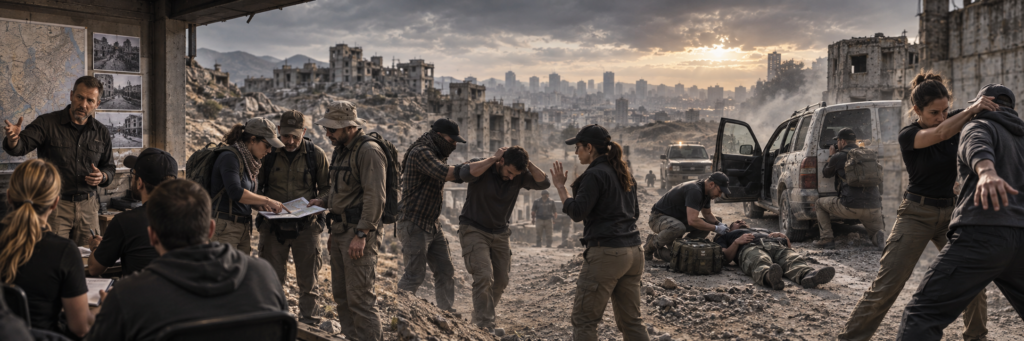
HEAT stands for Hostile Environment Awareness Training. Behind what may sound like an adventurous title is a simple idea: preparing someone to operate in an environment that no longer works with the familiar reference points they are used to.
A hostile environment is not necessarily a war zone. It may be a country affected by severe political instability, civil unrest, significant isolation, a natural disaster, high levels of crime, or simply a situation deteriorating rapidly. The danger therefore does not always come from a clearly identified threat; it can also emerge when ordinary conditions of travel, communication or work suddenly stop being reliable.
HEAT is not designed to turn a diplomat, engineer, humanitarian worker, manager or technician into a combatant. On the contrary, it aims to give them enough reference points to better understand their surroundings, recognise signs of deterioration, avoid certain situations while that is still possible, and retain useful reflexes when things no longer unfold as expected.
That is probably where its first value lies: learning to look differently. Faced with a serious event, the question is not only what to do once it has already happened. It is also about recognising early enough that the situation is changing.
2. At EPSA, GEOS Brings the Expertise
At EPSA, the SDS academy, we can now host HEAT courses delivered by GEOS, a French company specialising in risk management and international security. The division of responsibilities is deliberately clear: GEOS provides the trainer, methodology and teaching expertise; EPSA provides the training environment, the logistical support required for the exercises, and the role players who bring the scenarios to life.
That distinction matters. We do not claim an expertise that belongs to specialist trainers. Our role is to provide a controlled setting and sufficiently realistic situations so participants do not simply listen to theory, but are confronted with their own reactions, decisions, and sometimes mistakes. Awareness can sometimes come from brief experiences that remain memorable for a very long time.
Watching these courses has also made me look at situations I experienced many years ago differently. Behaviours, warning signs and precautions that once seemed almost natural to me now appear for what they really were: skills acquired through training and experience. And what has become obvious to someone accustomed to certain environments may be completely invisible to someone encountering them for the first time.
3. What Seems Obvious Is Not Always Obvious
For a long time, I never really thought of this type of preparation as a specific form of training. Some of the behaviours taught in HEAT had simply become natural to me: keeping a low profile, observing before acting, avoiding unnecessary discussion about one’s work, limiting ostentatious signs, understanding local customs, noticing what seems unusual, or simply accepting that the environment sometimes imposes its own rules.
With hindsight, I came to understand that none of those reflexes was innate. They came from my training, accumulated experience and the situations I had already faced. What I thought was common sense was actually the result of years of learning. And once certain mechanisms have been internalised for a long time, it is easy to forget that someone who has never encountered them cannot simply guess them.
That is probably one of the clearest benefits of HEAT: transmitting, in just a few days, part of that environmental awareness before the field teaches it in its own way. Experience remains an excellent teacher, but it often arrives after the fact. Preparation can sometimes help someone recognise earlier that a situation is beginning to deteriorate, preserving more options before it becomes genuinely hostile.
4. A Night in Eastern Chad
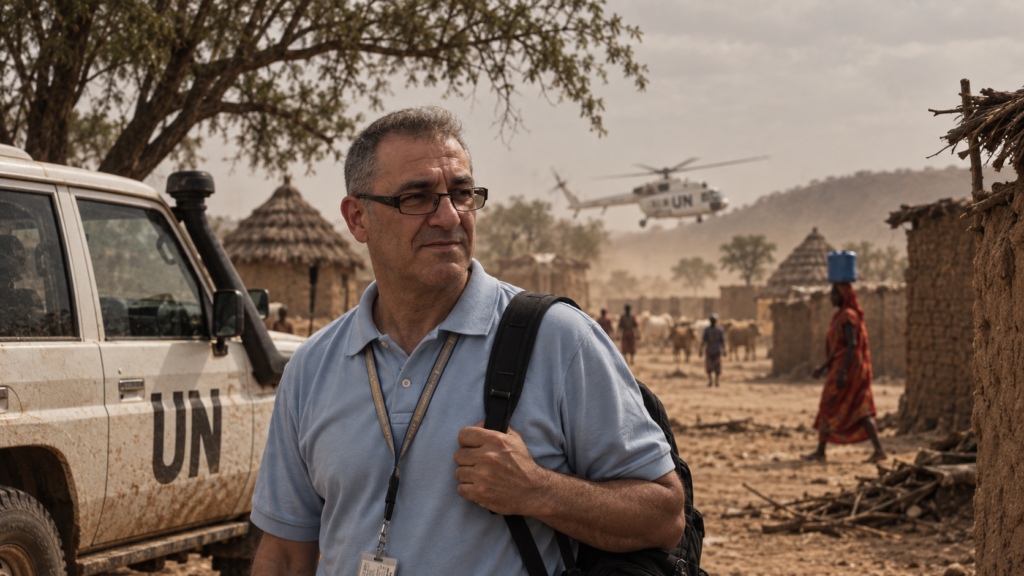
Several years ago, while I was deployed in eastern Chad as part of an international mission, a humanitarian organisation was subjected to an armed attack with very serious human consequences. Equipment and money were also stolen, and a young member of staff was deeply affected by what she had endured.
I was not there when the incident happened. I was alerted during the night and immediately became involved in what followed: first aid, securing the situation, initial reporting, gathering information and then investigations in the field. The gravity of what had happened was obviously striking, but with hindsight, that is not what taught me the most.
What struck me later was that some warning signs had been there before the attack. Living conditions were extremely precarious, resources were limited, protection was almost non-existent, and staff were highly exposed to their everyday environment. Yet for many of them, that environment had become normal. They were young, deeply committed to their mission, and willing to accept very difficult conditions to keep doing what they believed was useful.
I do not blame them. Quite the opposite: their commitment was real and worthy of respect. But commitment can make hardship acceptable without making it any less dangerous. When someone believes strongly in a mission, certain risks can gradually become part of the scenery.
After the event, it is always easier to reread the signs, understand the vulnerabilities and ask what might have been recognised earlier. It was precisely that gap which, many years later while watching HEAT courses, made me understand why specific preparation was necessary. Some things I had thought obvious were not obvious at all. They had simply become familiar to me.
5. Taking a Step Back to Understand More Clearly
During another mission, when fatigue and personal involvement were beginning to weigh heavily, a UNICEF ambassador once said something to me that stayed with me: “Christophe, you need to learn to become less emotionally involved in situations.” At the time, I did not want to hear it. Over time, I understood what she meant. It was not about becoming indifferent, but about maintaining enough distance to keep observing, analysing and making sound decisions when emotion is perfectly legitimate.
Commitment gives meaning to a mission. It can also make us accept more fatigue, discomfort or risk because the objective seems more important than ourselves. That is true for humanitarian workers, diplomats, technicians, managers and security personnel alike. Conviction is a strength; it simply must not become a blind spot.
I like to sum this up with a very simple image: when you keep your nose pressed against the picture, you eventually stop seeing the frame.
The longer you remain immersed in a situation, the more something that should alert you can begin to feel normal. You get used to poor accommodation, a risky journey, a bypassed rule, unusual behaviour or tension that rises slowly. Only by stepping back does the whole picture become visible again.
That is also what preparation such as HEAT can provide: creating that distance artificially before real experience imposes it. Not to remove commitment or spontaneity, but to give people a few more reference points so they can keep seeing the frame when the situation begins to change.
6. What HEAT Gives You Before Experience Forces It on You
HEAT does not try to reproduce the full complexity of a hostile environment in a few days. It provides reference points, simple reflexes and, above all, a way of reading the environment. Learning to observe your surroundings, plan a journey, maintain discretion, communicate properly, react under stress, identify the first signs of deterioration, or recognise the first actions that save lives already reduces improvisation considerably.
Scenario-based training has particular value here. As long as everything remains theoretical, we tend to believe that we will know what to do when the moment comes. But when stress, uncertainty, noise, fatigue or pressure appear, our real reaction can be very different from what we imagined. An exercise does not remove that human reaction; it simply lets people discover it in a controlled environment and gain experience before the consequences become real.
That is probably what I find most interesting about these courses now. Their value does not lie only in knowing what to do when things go wrong. It also lies in recognising earlier that they are beginning to go wrong. A change in atmosphere, a road that suddenly empties, unusual behaviour, contradictory information or a diffuse sense of tension can sometimes signal deterioration well before an incident becomes obvious.
HEAT therefore offers no universal recipe, nor does it guarantee that someone will always make the right decision. It does, however, provide more reference points for avoiding certain mistakes, interpreting the surroundings more accurately and keeping several options open for as long as possible.
That is the difference between learning after an event and preparing before it. Experience teaches afterwards. HEAT lets you gain part of that experience before the field sends you the bill.
7. Preparation Is Part of the Mission
A mission, business trip or international posting does not begin when someone arrives in the field. It begins before departure. Whether the person is a diplomat, engineer, technician, manager, consultant, sales representative, hotel employee, humanitarian worker or member of a project team, an organisation can perfectly well prepare the ticket, hotel, vehicle, appointments, insurance and work programme while forgetting the essential point: preparing the person for the context in which they will have to work — and, above all, live.
A professional can be excellent in their own field and still become completely disoriented by the environment in which that expertise suddenly has to be exercised. HEAT is therefore not reserved for war zones or a handful of specific profiles. More broadly, it concerns anyone, an institution, company, or organisation that may need to deploy to a country that is unstable, isolated, severely degraded, or simply very different from their usual environment.
Preparing someone to leave does not mean teaching them to be afraid. It means giving them enough reference points to preserve their judgement when familiar habits stop being reliable. That is part of the mission, just like logistics, insurance, administrative procedures and professional objectives.
No training can make a hostile environment safe. But serious preparation can prevent someone from being sent into it blind.
8. What I Would Do Differently Today
With hindsight, this reflection also forces me to look at my own responsibility. At the time, during Area Security Management Team (ASMT) meetings — the team responsible for managing security within the area — I probably should have gone further. I had seen some young staff living in extremely precarious conditions, with very limited means and, at times, almost no real protection. I gave them advice and tried to raise awareness, but I still too often regarded those conditions as simply part of the reality of the field.
Today, after discovering and observing HEAT courses, I think I should have been firmer. In some cases, it was probably not enough simply to advise people on how to protect themselves better. We should have requested changes to accommodations, challenged certain practices, and, above all, reported the real level of exposure more clearly so it could be addressed at the appropriate level.
That is another lesson experience teaches: sometimes we understand the risk to ourselves very well without fully appreciating the risk to which others are exposed. And sometimes what we call “the reality of the field” is nothing more than a vulnerability everyone has gradually become used to.
I obviously cannot rewrite what happened. But I can at least draw this lesson from what I missed: when a vulnerability becomes visible, it is not always enough to explain how to live with it. Sometimes the conditions that made it possible must be challenged, and action taken at every level before the field presents the bill.
Those who recognise themselves in this story will also understand that this mea culpa is addressed to them.