

A recording does not need to be false to become misleading. Sometimes, all it takes is the loss of context. As cameras and microphones become embedded in ordinary objects, sensitive organisations must learn to recognise this new risk — but above all, ensure that whatever may be captured can neither compromise information nor weaken the institution.
Two Seconds, One Photograph
At the turn of the 1990s and 2000s, when the first mobile phones capable of taking photographs began to appear, image quality was still poor, distribution was slow, and social media had none of the reach it has today. Yet even then, a few seconds were enough to create a problem when an image was separated from its context.
During a relatively tense public-order operation, a line of French gendarmes had prepared their protective equipment. One officer’s helmet visor accidentally dropped in front of his eyes. Rather than lifting it with his hand, he used the protective baton he was already holding. The movement lasted only a few seconds. At precisely that moment, someone took a photograph with one of the early flip phones fitted with a camera.
Frozen at the wrong moment, the image made it appear that the gendarme was raising his baton in an aggressive posture. The photograph circulated and eventually found its way back to his unit, where he had to explain an attitude which, once placed back in context, had been anything but offensive.
An image can be authentic and still tell a misleading story when its context is removed.
When an Everyday Object Becomes a Sensor
The issue has since changed scale. Recording technologies have been miniaturised to the point where they can be built into objects that would once have entered a site without attracting the slightest attention: glasses, watches, badges, pens, keyrings, lighters, USB drives, earphones or small accessories worn on the person.
Smart glasses are merely the most visible example. Some models combine a camera, microphones, local storage and wireless functions; some can even transmit, in real time, images captured without explicit consent. Other devices are far simpler: inexpensive camera glasses can record to internal memory or a microSD card without a phone, without Wi-Fi and without Bluetooth throughout their time on site.
This distinction is essential: asking a visitor to leave their phone at reception does not necessarily remove their ability to record. A device may capture and store video or audio locally, remain completely silent on the network, and transfer the data only after its wearer has left.
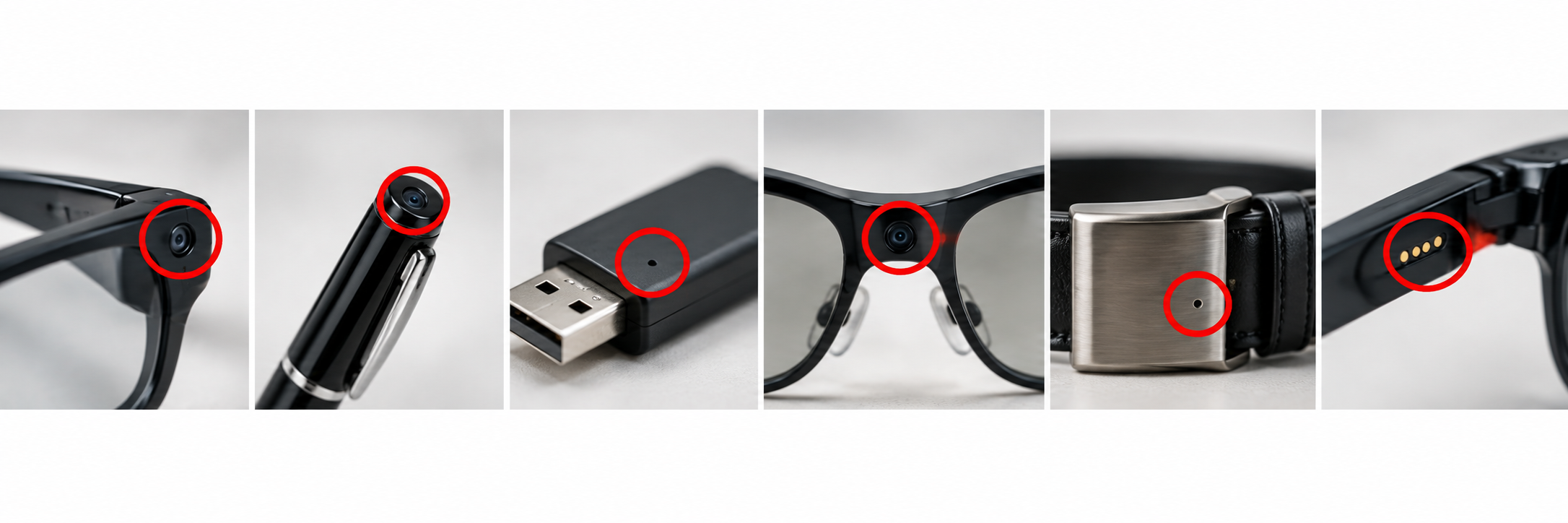
A Few Clues — Without Turning Reception into a Laboratory
A camera must see; a microphone must hear. This is the difference between components that may leave a visible clue and those that can remain entirely concealed. A camera needs an optical path to its sensor. A microphone needs an acoustic path, however small. By contrast, the battery, processor, internal memory, microSD card or radio module may be completely hidden inside a glasses arm or a small casing.
For a security officer, the aim is therefore not to memorise a catalogue of brands. It is to identify converging indicators: an optical opening near a hinge, an unusually thick arm, micro-perforations, a capture button, charging contacts, a touch-sensitive area or an obviously electronic case. None of these signs proves anything on its own; several together simply justify closer attention.
A few simple technical aids can support that judgement: magnified inspection, looking for lens retro-reflection, or detecting certain Bluetooth Low Energy, Wi-Fi or radio-frequency emissions. But these methods have limits. A device recording locally may emit nothing at all, while a diplomatic environment naturally contains many legitimate wireless devices. The techniques exist; their detail deliberately lies beyond the scope of this article.
Raise Awareness Rather Than Search Everyone
Technological progress should not turn an embassy reception area into a search room. Controls must remain proportionate to the confidentiality level of the zone, the context and the indicators observed. The first barrier is therefore awareness: security personnel and reception staff must understand what an ordinary object can now contain, and know when a doubt deserves to be reported.
In a genuinely sensitive area, the most robust response is often procedural: an electronic object that serves no necessary function stays outside. Controlled deposit, a locker or a clear access rule is generally more reliable than attempting to prove on the spot that a device is inactive.
Technology assists. Rules decide. Human judgement remains essential.
The Best Defence Is Still Exemplary Behaviour
Anyone who receives members of the public should assume that a word, a gesture, a screen or a document may one day be photographed, recorded or quoted out of context. This does not mean working in a state of anxiety or permanent suspicion. It simply means maintaining a professional environment that remains defensible even when it is being observed.
The gesture. Remain calm, measured and professional. A two-second posture can become a still image stripped of all context.
The words. Say only what is necessary. Avoid jokes, personal opinions, over-familiar remarks or operational explanations that would become difficult to defend if replayed later.
The environment. Keep sensitive documents out of sight, lock or reposition screens when receiving a visitor, and ensure that passwords, internal lists, schedules, boards or access-control information cannot be read from the visitor’s position.
If an interview must continue despite doubt about a device, the conversation should immediately return to the level of information strictly necessary for the visitor: identity, appointment, formalities and general instructions. Any sensitive discussion should be reserved for an authorised person and a controlled environment.
From Confidentiality to Reputation
The risk is not limited to intelligence gathering. The old photograph of the gendarme lifting his visor illustrates another vulnerability: the institution’s image. Today, a sequence can be published, cropped, commented on and redistributed before the organisation even knows it exists. An entirely ordinary scene can become a communications problem simply because the public sees only a fragment of it.
For an embassy, an international organisation or a corporate leadership team, confidentiality and reputation are now closely intertwined. A device may capture a secret; it may also capture two awkward seconds. In both cases, the consequences can extend far beyond the original scene.
Conclusion
The challenge created by the miniaturisation of recording technologies is not that every visitor has become a spy. It is that the boundary between an ordinary object and a recording device is becoming increasingly difficult to distinguish, while the copying, modification and dissemination of information have become almost instantaneous.
The response must therefore be twofold: awareness, proportionate controls and appropriate rules on one side; disciplined language, controlled gestures and a professional working environment on the other.
A security officer may fail to detect a concealed recorder. An employee may never know that a camera was present. But if the organisation has limited what could be captured, and if its personnel remain measured, precise and professional, the value of that recording falls considerably.
In this field, the best defence is still exemplary behaviour.